YouTube and Facebook Growth for Small Creators: How to Get More Views, Followers, and Better Reach
Growing on YouTube or Facebook can feel confusing when you are posting regularly but your videos are still getting very few views.
You may be asking:
- Why are my YouTube Shorts not getting views?
- Why did my Facebook Reel suddenly stop getting reach?
- How often should I post?
- What type of videos should I make?
- Do hashtags still matter?
- Should I use AI to create content?
- How can I get my first 1,000 subscribers or followers?
- Why do some small creators grow faster than others?
The good news is that you do not need a huge following to start growing.
You need the right topic, useful content, a strong opening, original ideas, and a simple system for learning from your results.
This guide explains how small creators can approach YouTube and Facebook in a practical way.
Quick Answer: What Actually Helps a Small Creator Grow?
For most small creators, the basic process is:
Find a real problem → create a useful video → make the value clear immediately → keep viewers interested → study the results → improve the next video.
There is no single trick that guarantees views.
YouTube says its recommendation systems look at signals related to whether people choose to watch, whether they continue watching, and whether they appear satisfied with the content. Competition and topic interest also affect how many people see a video.
Facebook is also placing more emphasis on original content and reducing the distribution of content that simply copies or makes minor changes to someone else’s work.
So instead of trying to “beat the algorithm,” focus on creating something people actually want to watch.
1. Why Small Creators Often Get Low Views
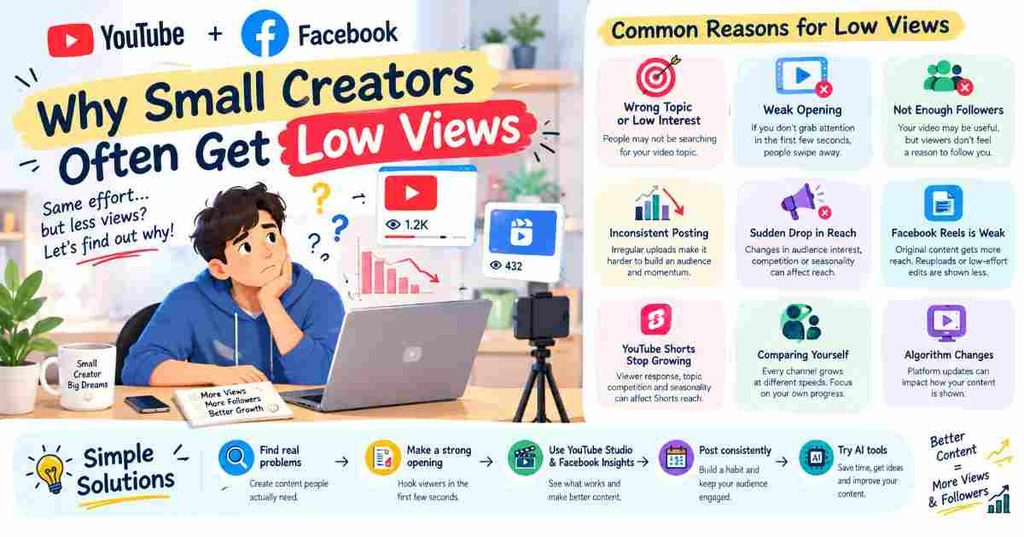
Getting low views does not automatically mean that your account is bad.
There are several possible reasons.
Common problems include:
| Problem | What it usually means |
|---|---|
| Low views | Topic, packaging, competition, or viewer response may be weak |
| People swipe away quickly | The opening may not create enough interest |
| Views but few followers | The video may be useful but not give viewers a reason to follow |
| Good videos but inconsistent growth | Topics or audience may be inconsistent |
| Sudden drop in reach | Audience interest, competition, seasonality, or content changes may be involved |
| Facebook reach is weak | Originality, relevance, engagement, or content quality may need attention |
| YouTube Shorts stop growing | Viewer response and topic competition may have changed |
YouTube specifically notes that topic interest, competition, and seasonality can affect Shorts reach.
That means you should not assume:
“My account is shadowbanned.”
First, look at the actual data.
2. Start With a Problem, Not a Video
One of the easiest mistakes is starting with:
“What video should I make today?”
Instead ask:
“What problem does my audience have today?”
For example, a YouTube creator might search for:
- Why are my Shorts getting 0 views?
- How do I get more subscribers?
- How long should a YouTube Short be?
- Why are people leaving my videos?
- How do I find video ideas?
A Facebook creator may ask:
- Why are my Reels not reaching people?
- How do I grow a Facebook page?
- How does Facebook monetization work?
- Why did my Reel lose reach?
- What type of original content should I post?
These are much better starting points because they represent actual problems.
3. How to Find Content Ideas That People Want
You do not have to guess every topic.
YouTube Studio has a Trends tab that can show top searches, breakout videos, recent videos, audience interest, and Shorts content gaps. YouTube describes a content gap as a situation where viewers cannot find enough relevant or high-quality results for a search.
A simple research process
Before creating a video:
- Open YouTube Studio.
- Go to Analytics → Trends.
- Search for your main topic.
- Look at related searches.
- Check breakout videos.
- Look for Shorts content gaps.
- Find questions people are asking.
- Create a better and more useful answer.
This is much better than randomly copying whatever another creator posted.
4. Use the “One Problem, One Solution” Formula
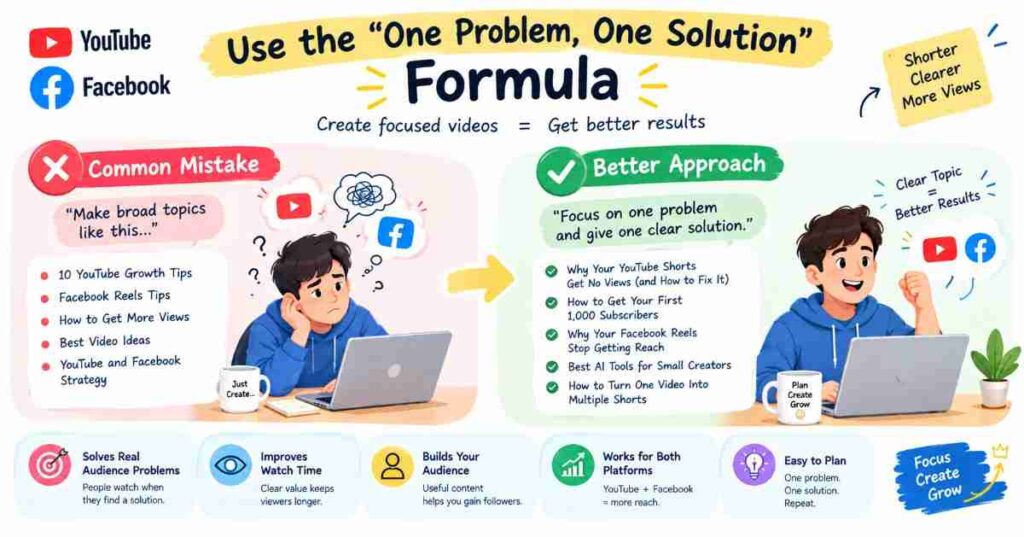
Small creators often try to put too much information into one Short or Reel.
Instead, use:
One video = one clear problem + one useful solution.
Weak topic
“10 YouTube Growth Tips”
This is broad and generic.
Better topic
“Why Your Shorts Get Views but No Subscribers”
Now the viewer immediately understands the problem.
Another example:
Weak
“Facebook Reels Tips”
Better
“Why Your Facebook Reels Suddenly Stop Getting Views”
The second version creates a much clearer reason to watch.
5. The First Few Seconds Matter
A viewer decides very quickly whether your content is worth watching.
YouTube says the opening moments are particularly important because viewers decide whether to stay or move on, especially for Shorts. It recommends making the introduction concise and delivering on the promise made by the title and thumbnail.
Avoid openings like:
“Hello guys, welcome back to my channel…”
“Today I am going to tell you…”
“Before we start, please subscribe…”
These openings may delay the actual value.
Try:
“If your Shorts get views but no subscribers, this may be the reason.”
Or:
“Your Facebook Reel may not need more hashtags. Check this first.”
Or:
“Getting 0 views on Shorts? Check these three things.”
The viewer should understand the reason to continue watching almost immediately.
6. How to Make Better YouTube Shorts
YouTube says Shorts recommendations are personalized and influenced by factors such as whether viewers choose to watch, how long they stay, and whether they appear to enjoy the content.
A simple Shorts structure is:
Hook
Tell the viewer what problem you are solving.
Value
Give the useful information quickly.
Example
Show how the advice works.
Ending
Give the next logical step.
For example:
Hook:
“Your Shorts are getting views but nobody subscribes?”
Value:
“Your videos may be answering random questions instead of building a clear topic.”
Example:
“If you post three videos about cooking, then one about gaming and another about phones, viewers may not know why they should follow.”
Ending:
“Choose one clear content theme and build a series around it.”
7. Don’t Chase Every Trending Topic
Trends can bring attention, but chasing every trend can damage your content strategy.
Imagine your channel is about smartphone tips.
One day you post:
- iPhone tips
- Android tips
- AI tools
- football news
- celebrity news
- cooking
- gaming
You may get random views, but you are not building a clear audience.
A better strategy is:
Trend + your niche + audience problem
For example:
New AI feature + smartphone users + how to use it
That gives you both freshness and relevance.
8. How to Use Facebook Reels Correctly
Facebook is increasingly emphasizing original content.
Meta says original content created directly by the creator is considered original, while simple reuploads and low-value edits of someone else’s content can be treated as unoriginal and may be deprioritized.
That means:
Better approach
Create your own:
- Script
- Voice
- Explanation
- Examples
- Commentary
- Editing
- Visual presentation
You can still discuss a popular topic.
The important difference is that you are adding something genuinely useful rather than simply copying another creator.
9. Can You Post the Same Video on YouTube and Facebook?
Yes, you can build content for both platforms.
But do not think of it as:
“Upload exactly the same thing everywhere and forget about it.”
Instead, create one original idea and adapt it.
Example
Main idea:
“Why Your Short Videos Get Views but No Followers”
You can turn it into:
YouTube Short:
A 30–45 second explanation.
Facebook Reel:
The same core lesson with a slightly different opening.
YouTube long-form video:
A deeper explanation with examples.
Facebook text post:
A short checklist.
Blog article:
A complete guide.
One idea can become multiple pieces of content.
10. How to Get More Subscribers and Followers
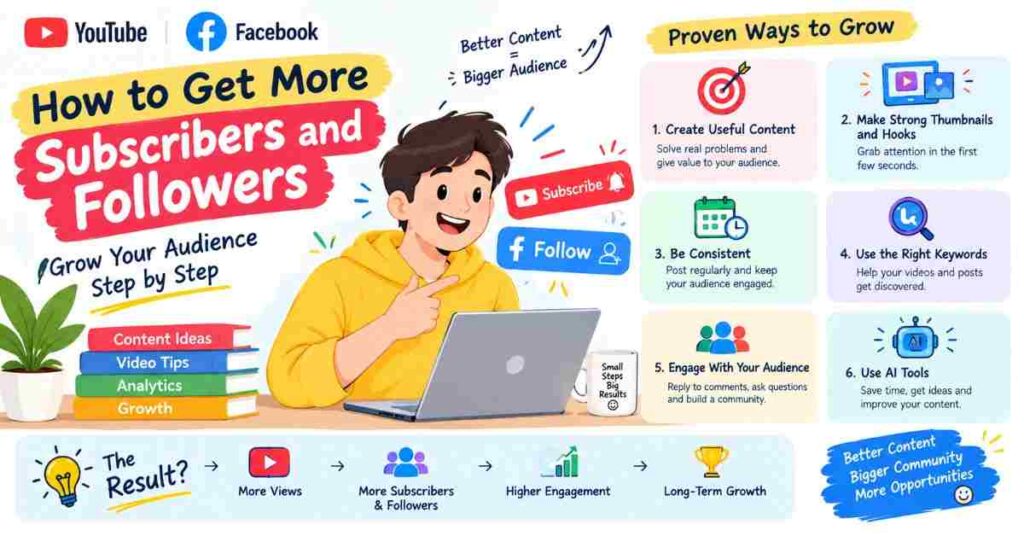
Views are not the same as audience growth.
A person may watch your video and leave.
So your content should answer:
“Why should this person follow me?”
The easiest way is to create a repeatable content theme.
For example:
Channel theme
YouTube Growth for Small Creators
Series:
- Why Your Shorts Get No Views
- Why Your Shorts Get Views but No Subscribers
- How to Find Better Video Ideas
- How to Improve Your Hook
- How to Read YouTube Analytics
- How to Find Content Gaps
Now viewers know what they can expect from your account.
11. Don’t Obsess Over Hashtags
Hashtags can help organize or describe content, but they are not a substitute for a useful video.
For YouTube, the platform says tags are primarily useful for common spelling mistakes and are not essential for discovery.
Your bigger priorities should be:
- Topic
- Viewer problem
- Hook
- Useful information
- Viewer retention
- Originality
- Clear title/packaging
Do not spend 30 minutes choosing hashtags if the video itself does not answer a clear question.
12. What Analytics Should You Watch?
You do not need to study every metric every day.
Start with a small set.
YouTube Shorts
Pay attention to:
- Views
- Shown in feed
- How many viewers chose to view
- Average view duration
- Average percentage viewed
- Subscribers gained
YouTube’s Shorts analytics specifically includes metrics such as views, subscribers, shown in feed, and the percentage of viewers who chose to view versus swipe away.
Ask yourself:
People saw it but didn’t watch?
Improve the hook.
People watched but left quickly?
Improve the content structure.
People watched but didn’t subscribe?
Improve your niche consistency and reason to follow.
13. Why Your Video Can Be Good but Still Get Few Views
This is important.
A good video does not automatically receive massive reach.
YouTube says external factors include topic interest, competition, and seasonality.
For example:
You make an excellent video about a very small topic.
The video may be useful, but only a small audience is currently interested in it.
Another creator may make an equally good video about a topic that millions of people are interested in.
So don’t judge your content only by production quality.
Ask:
Is there enough demand for this topic?
14. How AI Can Help Small Creators
AI can save time, but it should not replace your original thinking.
You can use AI for:
- Brainstorming ideas
- Finding different angles
- Creating outlines
- Improving hooks
- Turning long videos into short scripts
- Creating title variations
- Summarizing your own analytics
- Generating content calendars
- Translating content
- Creating rough scripts
YouTube itself is adding AI-assisted creator features. Its current Ask Studio can help creators brainstorm ideas, understand channel insights, and analyze performance.
But do not simply ask AI:
“Give me 100 viral video ideas.”
Instead give it a real problem:
“My audience is beginner YouTubers with fewer than 1,000 subscribers. Give me 20 common problems they face and turn each problem into a useful Short idea.”
The second approach produces much more focused content.
15. AI Should Help You Create — Not Copy
Using AI does not mean copying another creator’s content.
A better workflow is:
Research → AI assistance → Your experience → Original explanation → Final content
For example:
- Find a problem.
- Research the official platform documentation.
- Ask AI to organize the information.
- Add your own examples.
- Check the facts.
- Create your own video.
- Review the analytics.
- Improve the next version.
This creates something more useful than automatically generated content.
16. Facebook Monetization: What Creators Should Know
Facebook has been investing heavily in creator monetization.
Meta said Facebook paid creators nearly $3 billion in 2025, with 60% of total creator payouts going to Reels. Meta also said Facebook is putting more emphasis on original content, deeper engagement, longer watch time, and qualified views.
However, monetization availability and eligibility can depend on the account, country, program, and current Facebook requirements.
So don’t build a strategy around:
“Facebook will pay me if I get X views.”
Instead build around:
Create useful original content → build an audience → qualify for available monetization opportunities.
17. A Simple Weekly Content Plan
You don’t need to publish 10 times every day.
A small creator can start with a manageable system.
Monday
Problem-solving Short/Reel
Example:
Why your Shorts aren’t getting views
Tuesday
Quick tip
Example:
One way to improve your video hook
Wednesday
Question-based video
Example:
How often should a small creator post?
Thursday
Case study
Example:
Why this type of Short performs better
Friday
Trend + niche
Example:
New YouTube feature explained for small creators
Saturday
Common mistake
Example:
3 mistakes beginners make with Facebook Reels
Sunday
Analytics + learning
Look at your previous videos and identify:
- Best topic
- Best hook
- Best retention
- Best subscriber/follower result
- Worst-performing topic
Then use those findings to plan next week’s content.
18. The 70/20/10 Content Rule
A simple starting framework is:
70% — Evergreen problems
Content that can remain useful for months.
Examples:
- How to improve Shorts
- How to find video ideas
- How to read analytics
- How to create better hooks
20% — Trends
New features, popular topics, platform updates, creator trends.
10% — Experiments
Try something completely different.
This gives your website or social account a balance between long-term search demand and current trends.
19. 20 Blog Topics You Can Build Around
If you are creating a blog about YouTube and Facebook growth, these are good problem-focused categories:
- Why YouTube Shorts Get No Views
- Why YouTube Shorts Get Views but No Subscribers
- How to Find YouTube Content Gaps
- How to Find YouTube Video Ideas
- How to Improve YouTube Shorts Hooks
- How to Read YouTube Shorts Analytics
- How Often Should Small Creators Post?
- Why YouTube Views Suddenly Drop
- How to Turn One Video Into Multiple Shorts
- How to Grow a Small YouTube Channel
- Why Facebook Reels Get Low Reach
- Why Facebook Reels Suddenly Stop Getting Views
- How to Grow a Facebook Page From Zero
- Facebook Reels Ideas for Beginners
- How Facebook Original Content Works
- YouTube vs Facebook for Small Creators
- How to Post Videos on YouTube and Facebook
- Best AI Tools for Small Creators
- How to Use AI for YouTube Content
- How to Build a Content Plan With AI
These topics can then be expanded into hundreds of more specific questions.
20. The Best Long-Term Strategy
Do not build your entire website around one temporary feature.
For example, avoid making the entire site about:
“How to use the latest YouTube button.”
That feature could change.
Instead build around permanent creator problems:
Getting views
↓
Getting subscribers
↓
Finding content ideas
↓
Improving videos
↓
Understanding analytics
↓
Growing an audience
↓
Making money
The platforms will change.
The problems creators have will remain.
Final Takeaway
You do not need to become an overnight viral creator.
You need a repeatable system:
Find a real problem → create a clear solution → make the opening strong → provide value quickly → publish consistently → study the data → improve.
For a small creator, the goal should not be to copy the biggest YouTubers or Facebook creators.
Instead, become the creator who consistently answers the questions that beginners are actually asking.
That is where a small audience can become a loyal audience.
And if you are building a blog around this topic, don’t just write generic articles like “YouTube Tips.”
Build content around real problems:
Why is my Short not getting views?
Why did my Facebook Reel lose reach?
How do I find better video ideas?
How do I get my first 1,000 subscribers?
How can AI save me time as a small creator?
Those are the questions people need answers to — and they give you a much stronger foundation for SEO, AEO, GEO, and AI-answer visibility.
FAQ
Why are my YouTube Shorts getting no views?
There can be several reasons, including weak viewer response, limited topic interest, high competition, or seasonality. YouTube says Shorts distribution is influenced by viewer personalization and performance signals such as whether viewers choose to watch and whether they continue watching.
How do I get more views on Facebook Reels?
Start with a clear topic, strong opening, useful information, and original content. Facebook is currently emphasizing original content and reducing distribution for unoriginal or minimally changed copies.
Should I post every day on YouTube?
Not necessarily. A sustainable publishing schedule is more useful than forcing daily uploads. Study your analytics and focus on making content that your audience actually responds to.
Are hashtags important for YouTube Shorts?
They can provide context, but they are not the main growth factor. YouTube says tags are mainly useful for spelling variations and are not essential for discovery.
Can AI help me grow on YouTube?
AI can help with brainstorming, planning, analysis, scripting assistance, and other parts of the workflow. YouTube currently provides AI-assisted creator tools such as Ask Studio. However, AI output should be checked and improved rather than published blindly.
Can I use the same content on YouTube and Facebook?
You can adapt the same original idea for both platforms. However, create your own content and avoid simply copying other creators’ videos. Facebook currently places greater emphasis on original content.
How many followers do I need before I can grow?
There is no universal number. A small account can grow when individual pieces of content reach people who are genuinely interested in the topic. Focus first on solving a specific audience problem.