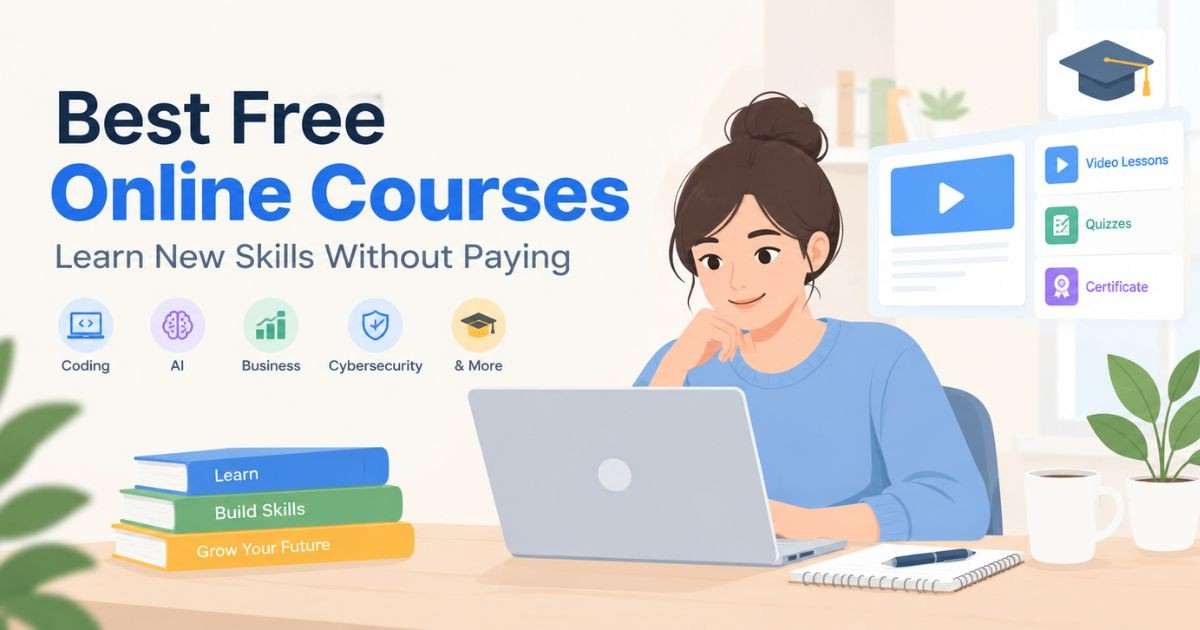
Discover the best free online courses in 2026 for AI, coding, business, cybersecurity, math and more. Compare platforms, courses and certificates.
Learning online has become one of the easiest ways to build new skills without going back to college or spending thousands of dollars on tuition. Whether you want to learn programming, business, digital marketing, artificial intelligence, cybersecurity, mathematics, writing, or another subject, there are reputable platforms offering free learning opportunities.
However, there is an important difference between a completely free course, a free audit, a free course preview, and a paid course with financial aid.
In this guide, we cover some of the best places to find free online courses in 2026, what each platform offers, who it is best for, and whether you can receive a certificate without paying.
What Are the Best Free Online Courses?
The best free online courses are not necessarily the ones with the biggest number of lessons. A useful course should have reliable educational content, a clear learning path, practical exercises where appropriate, and information that matches your current skill level.
Some of the strongest options include:
- MIT OpenCourseWare – university-level learning materials from MIT
- Khan Academy – completely free learning across many academic subjects
- freeCodeCamp – free coding curriculum and certifications
- OpenLearn – hundreds of free courses from The Open University
- edX – free audit access to many courses from universities and institutions
- Coursera – free previews and selected free learning options, with paid features available
- Google Career Certificates and learning resources – career-focused training, although the professional certificates themselves are generally paid
- MIT Open Learning Library – free interactive learning resources from MIT
The right option depends on what you want to learn and whether you need a certificate.
Best Free Online Course Platforms
1. MIT OpenCourseWare
Best for: University-level education, science, engineering, mathematics, computer science and self-study
Official Website :- MIT OpenCourseWare
MIT OpenCourseWare is one of the strongest choices for learners who want access to university-level educational material without paying tuition.
MIT says its OpenCourseWare collection includes material from more than 2,500 MIT courses covering its curriculum. The resources can be accessed without enrollment, and there are no start or end dates.
You can find subjects including:
- Computer science
- Programming
- Mathematics
- Physics
- Engineering
- Economics
- Biology
- Chemistry
- Business
- Artificial intelligence
- Sustainability
- Humanities
MIT also provides dedicated programming resources covering Python, Java, C/C++, MATLAB and other subjects.
Is MIT OpenCourseWare really free?
Yes. The educational materials are freely available.
There is one important limitation: MIT OpenCourseWare does not provide academic credit or certificates for completing its materials.
That makes it particularly useful if your goal is knowledge and skill development rather than adding a certificate to your résumé.
Example MIT courses to explore
- Introduction to Computer Science and Programming in Python
- Introduction to Computational Thinking and Data Science
- Introduction to Algorithms
- Single Variable Calculus
- Classical Mechanics
- Fundamentals of Biology
- Principles of Microeconomics
2. Khan Academy
Best for: Students, beginners and academic subjects
Official Website :- Khan Academy
Khan Academy is a nonprofit educational platform offering free learning resources across a wide range of subjects.
According to Khan Academy, its library of videos, articles, practice questions and lessons is available free of charge.
It is especially useful for learners who want to strengthen their foundations before moving to more advanced subjects.
Popular areas include:
- Mathematics
- Science
- Economics
- Computing
- Test preparation
- Grammar
- History
- Arts and humanities
Who should use Khan Academy?
Khan Academy is particularly useful for:
- School students
- College students reviewing fundamentals
- Adult learners
- People preparing for academic tests
- Anyone who wants structured practice
If you are starting from zero, Khan Academy can be easier to approach than advanced university-level resources.
3. freeCodeCamp
Best for: Programming, web development and software development
Official Website :- freeCodeCamp
If your goal is to learn coding without paying for a bootcamp, freeCodeCamp is one of the most useful options available.
Its curriculum is self-paced and completely free. freeCodeCamp currently offers developer certifications covering areas such as:
- Responsive Web Design
- JavaScript
- Front-End Development Libraries
- Python
- Relational Databases
- Back-End Development and APIs
The certifications involve interactive lessons, projects, quizzes and exams.
Why freeCodeCamp stands out
Unlike resources that only provide videos, freeCodeCamp emphasizes hands-on learning.
You can:
- Learn a concept.
- Complete interactive exercises.
- Build projects.
- Practice your skills.
- Complete certification requirements.
The organization says its certifications are free and can be linked from a résumé or LinkedIn profile.
For someone who wants to build a portfolio while learning programming, this can be especially useful.
4. OpenLearn
Best for: General education, business, technology, health, languages and personal development
Official Website :- OpenLearn by The Open University
OpenLearn is The Open University’s free learning platform.
The Open University states that its OpenLearn courses are free to study and offers hundreds of courses across nine broad subject areas.
The catalogue covers areas such as:
- Money and business
- Education
- Health and psychology
- History and arts
- Languages
- Nature and environment
- Science and mathematics
- Society and law
- Digital and computing
OpenLearn currently lists hundreds of free courses, with its catalogue showing hundreds of options across different levels and durations.
Interesting free OpenLearn topics
Some examples include:
- Introduction to artificial intelligence
- AI fluency
- Introduction to cybersecurity
- Digital skills
- Computer systems
- Business communication
- Leadership
- Environmental studies
OpenLearn also has a dedicated digital and computing section with courses covering cybersecurity, coding, digital skills and AI-related subjects.
5. edX
Best for: University courses, professional skills and academic subjects
Official Website :- edX
edX provides online courses from universities and institutions around the world.
One important point is that edX’s free option is generally an audit track rather than the complete paid course experience.
According to edX’s current help documentation, most courses have a free audit option. The audit track provides access to course readings and videos, but generally excludes graded assignments and certificates.
What can you learn on edX?
Depending on the course, you can find subjects such as:
- Computer science
- Artificial intelligence
- Data science
- Business
- Economics
- Engineering
- Mathematics
- Humanities
- Cybersecurity
- Programming
Can you get an edX certificate for free?
Usually, no.
The free audit track does not include a verified certificate. edX says verified-track pricing varies by course and that certificates and graded assessments are part of the paid experience.
So edX is an excellent option if your primary goal is learning for free, but you should not assume that the certificate is free.
6. Coursera
Best for: Career skills, university courses, professional certificates and structured learning
Official Website :- Coursera
Coursera hosts courses and programs from universities and companies around the world.
However, its free-access model has changed over time, so it is important to check the specific course before claiming that the entire course is free.
Coursera currently says many courses provide a free course preview, while some learning programs may offer other free options. Financial aid is also available for eligible learners in selected programs.
What can you learn on Coursera?
Popular areas include:
- Artificial intelligence
- Data science
- Business
- Digital marketing
- Project management
- Programming
- Cybersecurity
- Google career skills
- UX design
- Machine learning
Is Coursera completely free?
Not every course is completely free.
For many courses, you can preview the first module without paying. Some courses or programs may have additional free-access options, while certificates and full course access may require payment. Financial aid may also be available for eligible programs.
Therefore, always check the individual course’s enrollment page before assuming that the full course and certificate are free.
7. MIT Open Learning Library
Best for: Interactive university-level learning
Official Website :- MIT Open Learning Library
MIT’s Open Learning Library provides selected educational content from MIT OpenCourseWare and MITx.
The library includes interactive learning experiences with assessments and progress tracking. MIT says these materials can be accessed free of charge, although the library does not provide certificates.
Examples include:
- Introduction to Machine Learning
- Mathematics for Computer Science
- Quantum Information Science
- Structure of Materials
This is a good option for learners who prefer interactive material instead of simply watching lectures.
Best Free Online Courses by Category
Instead of choosing a platform randomly, start with your goal.
| Goal | Recommended Platform |
|---|---|
| Learn programming | freeCodeCamp |
| Learn Python | freeCodeCamp / MIT OpenCourseWare |
| Learn mathematics | Khan Academy / MIT OpenCourseWare |
| Learn science | Khan Academy / MIT OpenCourseWare |
| Learn AI fundamentals | OpenLearn / MIT resources |
| Learn cybersecurity | OpenLearn / edX |
| Learn business | OpenLearn / Coursera / edX |
| Learn economics | Khan Academy / MIT OpenCourseWare |
| Learn university-level subjects | MIT OpenCourseWare / edX |
| Build coding projects | freeCodeCamp |
| Explore many general subjects | OpenLearn |
| Learn interactively | MIT Open Learning Library |
Best Free Online Courses & Platforms Comparison
| Platform | Main Courses / Subjects | Free Learning | Free Certificate | Skill Level | Best For |
|---|---|---|---|---|---|
| MIT OpenCourseWare | Computer Science, AI, Mathematics, Physics, Engineering, Business | ✅ Yes | ❌ No | Beginner–Advanced | University-level learning |
| Khan Academy | Math, Science, Computing, Economics, History | ✅ Yes | ❌ Not its main model | Beginner–Intermediate | Students & fundamentals |
| freeCodeCamp | HTML, CSS, JavaScript, Python, Data, APIs, Databases | ✅ Yes | ✅ Yes, for its certifications | Beginner–Advanced | Programming & web development |
| OpenLearn | Business, AI, Computing, Cybersecurity, Science, Languages, Health | ✅ Yes | ⚠️ Depends on course/credential | Beginner–Advanced | General & professional learning |
| edX | Computer Science, AI, Business, Data Science, Engineering | ✅ Audit available | ❌ Audit certificate not included | Beginner–Advanced | University & professional subjects |
| Coursera | AI, Business, Marketing, Data Science, IT, UX, Cybersecurity | ⚠️ Free options/preview | ❌ Usually paid | Beginner–Advanced | Career-focused learning |
| MIT Open Learning Library | Computer Science, Machine Learning, Mathematics, Science | ✅ Yes | ❌ No | Intermediate–Advanced | Interactive university learning |
Best Free Online Courses for Beginners
If you are completely new to online learning, don’t start with the most advanced course you can find.
A better approach is to choose one skill and build gradually.
For programming
Start with:
- Basic computer concepts
- Python or JavaScript fundamentals
- Basic programming logic
- Small projects
- Data structures
- APIs and databases
- Larger portfolio projects
freeCodeCamp and MIT OpenCourseWare both provide strong resources for this path.
For business
Start with:
- Business fundamentals
- Marketing
- Communication
- Financial basics
- Data analysis
- Project management
- Entrepreneurship
OpenLearn and Coursera have broad business-related learning options.
For artificial intelligence
A beginner-friendly path can look like:
- Basic computer concepts
- AI fundamentals
- Generative AI concepts
- Prompting and AI tools
- Python basics
- Machine learning fundamentals
- Practical AI projects
OpenLearn currently lists free courses such as An Introduction to Artificial Intelligence and AI Fluency, while MIT provides more advanced computer science and AI-related learning resources.
Free Course vs Free Certificate: What’s the Difference?
This is one of the most important things to understand before enrolling.
Completely free learning
You can access the educational material without paying.
Examples include:
- Khan Academy
- MIT OpenCourseWare
- freeCodeCamp
- OpenLearn
Free audit
You can study selected course material without paying, but some features may be unavailable.
edX is a good example. Its audit track provides course readings and videos but generally does not include graded assignments or certificates.
Free preview
You can access part of a course before deciding whether to pay.
Coursera currently uses free previews for many courses, while full access and certificates may require payment.
Paid certificate
You may learn some or all of the material for free but pay if you want a verified credential.
This model is common on large online learning platforms.
Can Free Online Courses Help You Get a Job?
Yes, but a course certificate alone does not guarantee employment.
The value of an online course depends on the skill you develop and how you demonstrate it.
For example, someone learning web development could create:
- A personal website
- A business website
- A JavaScript application
- A Python project
- An API project
- A database project
A person learning digital marketing could create:
- An SEO case study
- A keyword research report
- A content strategy
- A website audit
- A sample advertising campaign
A person learning data analysis could build:
- Excel dashboards
- SQL projects
- Data visualizations
- Business reports
- Portfolio case studies
In many practical fields, demonstrating what you can actually do can be more useful than simply collecting certificates.
How to Choose the Right Free Online Course
Before starting a course, ask these questions:
1. What exactly do I want to learn?
Avoid choosing a course simply because it is popular.
Choose a specific goal.
For example:
“I want to learn Python for data analysis.”
is much better than:
“I want to learn technology.”
2. What is my current level?
Check whether the course is:
- Beginner
- Intermediate
- Advanced
Starting with an advanced course can make learning unnecessarily difficult.
3. Is the course really free?
Look carefully at the enrollment information.
Check whether “free” means:
- Full course
- Audit
- Preview
- Free trial
- Free learning materials
- Financial aid
These are not the same thing.
4. Is a certificate included?
If a certificate matters to you, verify this before starting.
For example, MIT OpenCourseWare explicitly does not provide certificates, while freeCodeCamp offers free certifications after completing its certification requirements.
5. Does the course include practical work?
For technical skills, practical projects can be particularly valuable.
Look for:
- Exercises
- Projects
- Quizzes
- Labs
- Coding challenges
- Assignments
How to Learn Online for Free Without Getting Overwhelmed
One common mistake is signing up for ten courses and completing none of them.
Instead, choose one primary skill.
For example:
Month 1: Learn the fundamentals
Month 2: Practice with small projects
Month 3: Build a portfolio project
Month 4: Learn an advanced topic
Month 5: Build another project
Month 6: Apply your skill to real-world work
You don’t need to study for eight hours every day.
Even 30–60 minutes of consistent learning can produce meaningful progress over time.
Best Free Online Course Platforms at a Glance
| Platform | Free Learning | Certificate Free? | Best For |
|---|---|---|---|
| MIT OpenCourseWare | Yes | No | University-level learning |
| Khan Academy | Yes | Not its main model | Academic subjects |
| freeCodeCamp | Yes | Yes, for its certifications | Programming |
| OpenLearn | Yes | Depends on course/badge | General education |
| edX | Audit available for most courses | No for audit | University & professional subjects |
| Coursera | Free previews/selected options | Usually not included in free access | Career & professional learning |
| MIT Open Learning Library | Yes | No | Interactive MIT learning |
Frequently Asked Questions
Are online courses really free?
Some are completely free, while others provide free audits, previews, or selected free content. Always check the individual platform and course before enrolling.
Which website offers completely free online courses?
Several platforms offer substantial free learning. MIT OpenCourseWare, Khan Academy, freeCodeCamp and OpenLearn are notable examples, although their learning models differ.
Can I get a free certificate online?
Yes, some platforms offer free certifications. freeCodeCamp, for example, offers free developer certifications after completing its requirements. Other platforms may charge for verified certificates.
Does MIT offer free online courses?
Yes. MIT OpenCourseWare provides free access to educational materials from more than 2,500 MIT courses. However, OCW does not provide certificates or academic credit.
Is Khan Academy completely free?
Khan Academy says its learning library of videos, articles, practice questions and lessons is free to use.
Is freeCodeCamp actually free?
Yes. freeCodeCamp describes its full-stack curriculum as completely free and offers several free developer certifications.
Is edX free?
Many edX courses can be audited for free. However, the free audit track generally does not include graded assignments or certificates.
Is Coursera free?
Coursera offers free previews for many courses and selected free learning options, but full course access and certificates may require payment. Eligible learners can also apply for financial aid in selected programs.
What is the best free online course for getting a job?
There is no single course that guarantees a job. Choose a course connected to the career you want and prioritize practical projects, relevant skills and a portfolio.
Are free online courses worth it?
They can be very useful when you choose a course that matches your goal and actually practice what you learn. Free resources can help you build knowledge and practical skills without the cost of traditional education.
Final Thoughts
You don’t need to spend thousands of dollars to start learning a valuable skill online.
If you want academic-level material, explore MIT OpenCourseWare. If you need school and foundational learning, Khan Academy is a strong starting point. For programming and development, freeCodeCamp offers a hands-on path with free certifications. OpenLearn is useful for exploring a broad range of subjects, while edX and Coursera provide access to university and professional learning through different free-access models.
The most important thing is not how many courses you complete. Choose one useful skill, learn consistently, practice it, and create something with it.
That is how a free online course can turn into a real-world skill.